


Most Battery Problems Start Long Before Failure
Battery failures rarely happen without warning. In professional production environments, most battery issues can be traced back to a handful of preventable stress factors.
Understanding these risks helps crews improve safety, extend battery lifespan, and avoid costly downtime on set.
Mechanical Damage
Drops, bent mounting rails, cracked connectors, and compromised housings can create hidden internal damage even when a battery appears to function normally.
Charging Abuse
Improper chargers, damaged cables, and poor charging conditions can create unnecessary stress that impacts both battery safety and long-term performance.
Improper Storage Habits
Storing batteries fully charged, deeply depleted, or in hot environments can significantly reduce lifespan and long-term reliability.
Water / Moisture Intrusion
Condensation, humidity, and water exposure can damage internal cells and circuitry long after visible moisture exposure occurs.
Heat Exposure
Excessive heat during charging, storage, or operation dramatically accelerates battery degradation and increases long-term safety risks.
Electrical Overstress
Exceeding current limits, using improper adapters, or powering incompatible high-draw equipment can overstress battery systems and increase failure risk.
How Professional Crews Manage Battery Systems
Professional productions don’t treat batteries as disposable accessories. Reliable power requires disciplined charging, storage, tracking, and fleet management practices.

Battery Safe Zones

Fleet Rotation

Runtime Tracking

Regular Inspection
Recommended Charging & Storage Practices
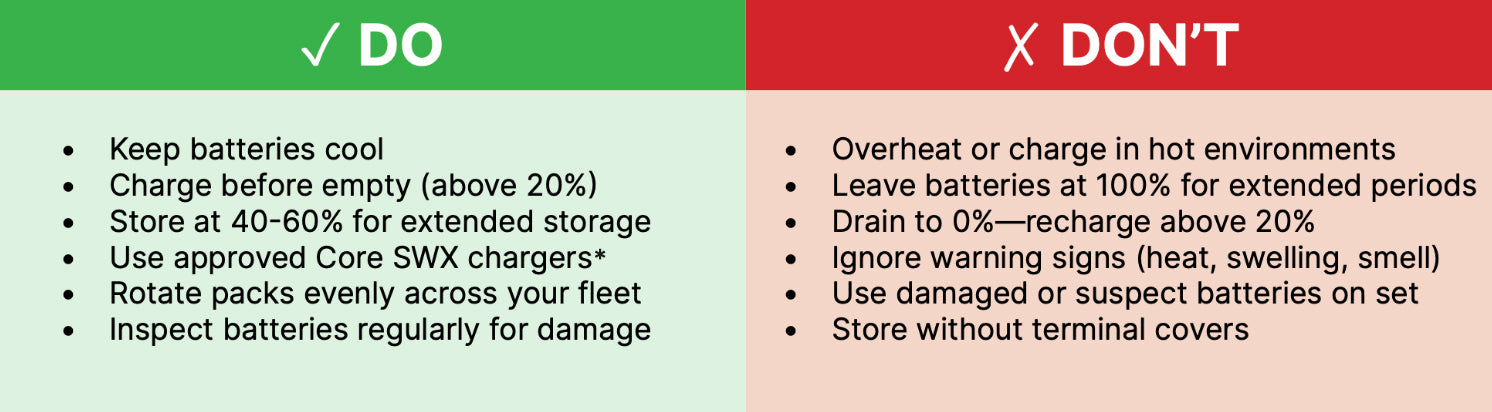
*Core SWX products are designed to support compatibility with many industry-standard charging solutions, and we understand real-world productions often operate mixed charger ecosystems. If you have questions regarding charger compatibility, charging behavior, or supported charging methods, please contact Core SWX support.
Warning Signs You Should Never Ignore
- Battery Running Hot - Potential internal damage or overcharge issue.
- Sudden Runtime Loss - Possible cell degradation or imbalance.
- Swelling or Deformation - Immediate removal from service required.
- Voltage Sag Under Load - Indicates elevated internal resistance.
- Sweet / Chemical Smell - Potential electrolyte venting hazard.
Professional Power Is More Than Watt-Hours
Modern production batteries are intelligent power systems designed to safely manage charging, discharging, thermal conditions, runtime accuracy, and equipment protection.
Professional battery systems combine:
- advanced BMS protection
- communication protocols
- runtime intelligence
- thermal management
- certified transport compliance
- high-current delivery stability
to improve both reliability and long-term performance in demanding production environments.
How Core SWX Approaches Professional Power
Core SWX battery platforms are designed around real-world production workflows, combining intelligent battery management systems, runtime visibility tools, charger communication protocols, and high-current delivery systems to support demanding professional environments.
Some Core SWX platforms also incorporate:
- runtime estimation displays
- VoltBridge iD battery diagnostics
- customizable ColorID fleet labeling
- advanced charger communication systems
to help crews better manage power on set.