

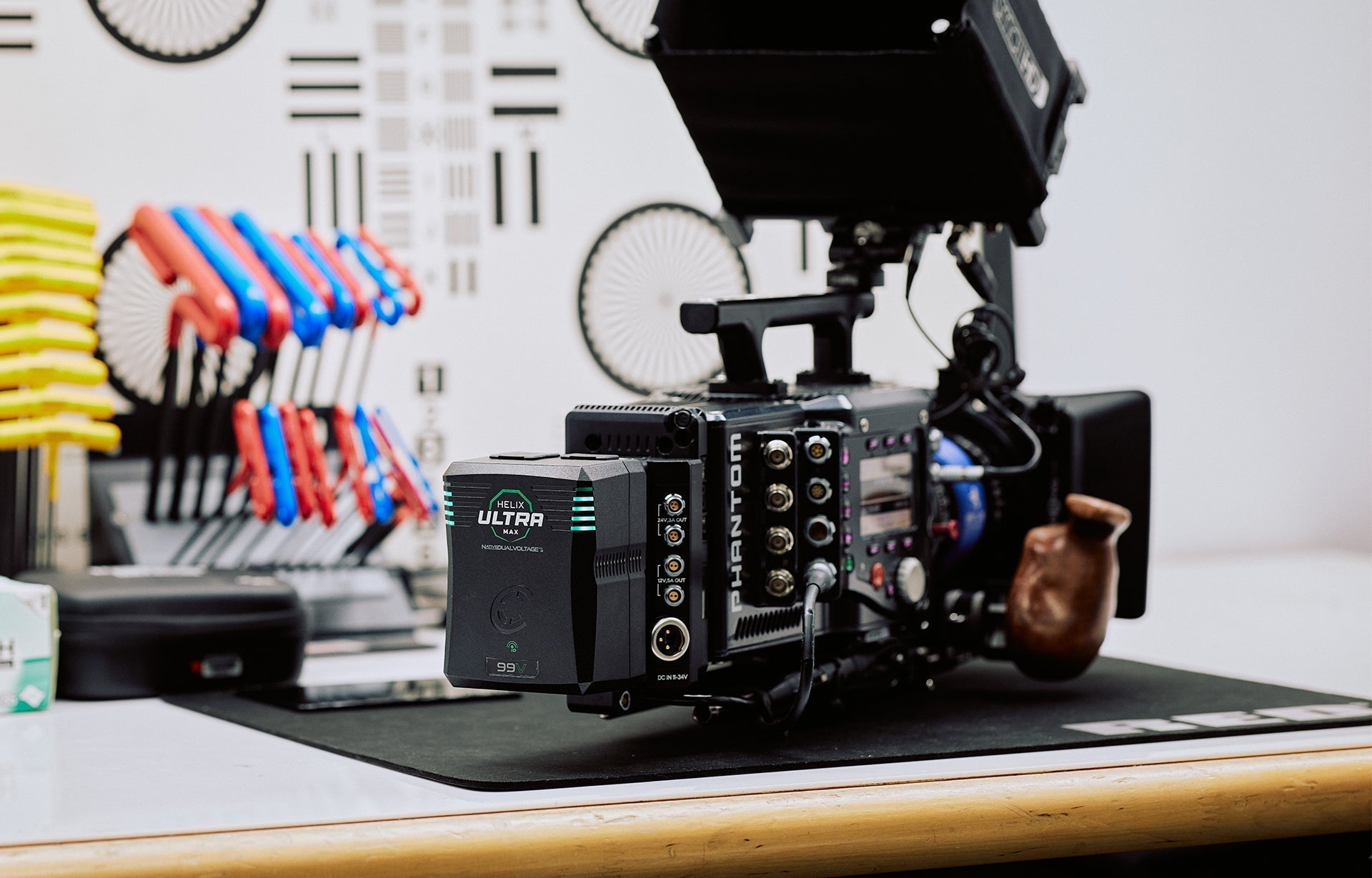
Why modern cinema cameras demand more from their power systems than ever before.
Estimated Reading Time: 7 Minutes
The Camera Has Changed
For decades, the primary responsibility of a camera battery was relatively straightforward.
Provide stable voltage.
Deliver enough runtime.
Recharge reliably.
Beyond that, the battery largely remained invisible.
Today’s professional cinema cameras tell a very different story.
Modern camera systems have evolved into extraordinarily sophisticated computing platforms.
They capture higher resolutions, process greater amounts of image data, support advanced
codecs, manage complex networking functions, communicate with intelligent accessories, and power entire ecosystems of connected devices—all while operating within increasingly compact form factors.
As cameras have become smarter, the battery powering them has had to become smarter as well.
Today’s professional power platform is no longer just supplying electricity.
It’s participating in a much larger system.
More Than a Camera
Walk around a modern cinema rig and count how many devices are drawing power from the battery.
The camera.
Wireless video transmitters.
Lens motors.
On-board monitors.
Audio receivers.
Follow focus systems.
Timecode generators.
Wireless networking devices.
External recorders.
Production monitors.
What was once a single power source has become the heart of an interconnected production ecosystem.
Every accessory adds current demand.
Every connection introduces another point of interaction.
Every new capability places greater expectations on the battery platform supporting the system.
Reliable power is no longer measured simply by runtime.
It’s measured by how consistently that entire ecosystem performs throughout the day.

Peak Power Matters More Than Ever
Capacity tells you how much energy is available.
It says very little about how quickly that energy can be delivered.
Modern cameras routinely experience rapid changes in power demand.
Recording begins.
Cooling systems increase speed.
Displays brighten.
Accessories activate simultaneously.
Wireless systems transmit data.
Power consumption is no longer constant.
Instead, batteries must respond to dynamic operating conditions while maintaining stable output.
Delivering consistent voltage during those moments has become just as important as overall runtime.
This is where engineering begins to matter far more than capacity alone.
Capacity tells you how much energy is available.
It says very little about how quickly that energy can be delivered.
Modern cameras routinely experience rapid changes in power demand.
Recording begins.
Cooling systems increase speed.
Displays brighten.
Accessories activate simultaneously.
Wireless systems transmit data.
Power consumption is no longer constant.
Instead, batteries must respond to dynamic operating conditions while maintaining stable output.
Delivering consistent voltage during those moments has become just as important as overall runtime.
This is where engineering begins to matter far more than capacity alone.
Communication Has Become Part of the Job
Power delivery is only one responsibility of a modern professional battery.
Increasingly, batteries also communicate with the equipment they power.
State of charge.
Remaining runtime.
Battery identification.
Charging information.
Diagnostics.
System status.
As camera ecosystems become more intelligent, reliable communication becomes increasingly important.
That communication is now part of the overall user experience.
When everything functions as expected, it’s almost invisible.
Which is exactly how it should be.

Smaller Doesn’t Mean Simpler
Professional equipment continues becoming more compact.
At the same time, power requirements continue increasing.
That creates one of engineering’s greatest challenges.
More power.
Less space.
Less weight.
More electronics.
Higher efficiency.
Improved thermal performance.
Greater reliability.
These objectives often compete with one another.
Improving one characteristic may introduce challenges somewhere else.
Every engineering decision becomes a balancing act.
The goal isn’t maximizing a single specification.
It’s optimizing the complete system.
Designing for the Unknown
One of the realities of engineering is that new camera platforms rarely stand still.
Firmware evolves.
Accessories evolve.
Production workflows evolve.
Five years after launch, a camera may be used in ways nobody originally anticipated.
That means battery platforms must be designed with flexibility.
Electrical margin.
Thermal margin.
Processing capability.
Communication robustness.
Expandability.
Future compatibility.
Good engineering isn’t only about meeting today’s requirements.
It’s about anticipating tomorrow’s.
“The best power platforms aren’t engineered only for the cameras of today—they’re designed with the cameras of tomorrow in mind.”
Continuous Engineering
Professional power platforms don’t become better through marketing.
They become better through engineering.
Every new generation teaches something.
Laboratory validation.
Field experience.
Customer feedback.
Changing production workflows.
Advancing camera technology.
Each lesson becomes another opportunity to improve architecture, refine firmware, strengthen communication, optimize thermal performance, or increase long-term reliability.
One example of this philosophy can be found in Ultra’s redesigned communication architecture, which isolates and validates communication before it reaches the battery management controller. The result is a more robust platform designed for long-term reliability across modern camera systems.
It’s one example of a much broader engineering approach.
Because designing for modern camera platforms means continually adapting as those platforms continue to evolve.
Looking Ahead
Camera technology shows no signs of slowing down.
Artificial intelligence.
Higher frame rates.
Greater resolutions.
Cloud-connected workflows.
Remote production.
Integrated networking.
Every advancement increases expectations placed on the battery powering the system.
Professional power platforms must continue evolving alongside them.
At Core SWX, we believe batteries shouldn’t simply keep pace with camera technology.
They should help enable what’s next.
Key Takeaways
-
Modern cinema cameras function as intelligent computing platforms rather than simple image capture devices.
-
Professional batteries now power complete production ecosystems—not just cameras.
-
Peak current delivery, communication, thermal performance, and system architecture have become essential engineering considerations.
-
Designing for modern camera platforms requires flexibility, engineering margin, and continuous refinement.
-
Ultra’s redesigned communication architecture is one example of how engineering continues evolving alongside professional production technology.
About the Author
Ross Kanarek
CEO | Core SWX
Ross Kanarek has spent more than two decades developing professional power solutions for the cinema and broadcast industries. Throughout the industry’s transition from traditional battery platforms to today’s intelligent, high-voltage camera ecosystems, he and his team has worked closely with manufacturers, rental houses, broadcasters, and cinematographers to develop products that meet the evolving demands of professional production.

Share:
Beyond Capacity
Reliability Starts with Architecture