

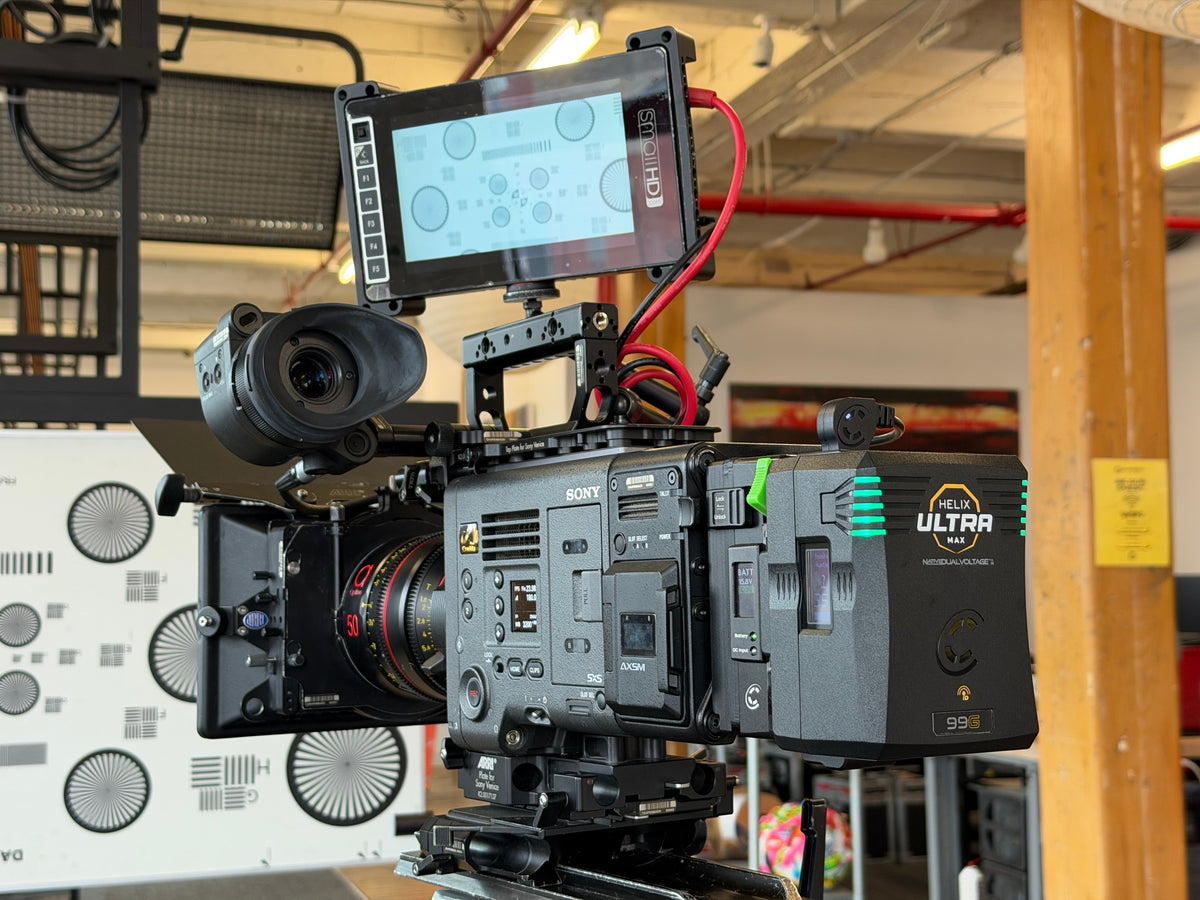
Long-term performance is engineered over the entire life of the battery—not just for the day it leaves the factory.
Estimated Reading Time: 7 Minutes
Day One Is the Easy Part
Most new batteries perform well on day one.
The more meaningful question is what happens later.
After hundreds of charge cycles.
After years of transportation.
After repeated high-current operation.
After exposure to heat and cold.
After being charged overnight, discharged on set, transported to another location, and put back into service the next morning.
Professional batteries live demanding lives.
For owner/operators, broadcasters and rental houses, a battery isn’t expected to perform for a few months. It’s an asset expected to remain dependable through years of professional use.
That’s why designing a battery for maximum initial performance isn’t enough.
It has to be designed for long-term performance.
And that requires thinking about the entire system—from cell selection and charging behavior to thermal management, protection, mechanical construction, firmware, and validation.
A professional battery shouldn’t only perform when it’s new.
It should be engineered around what happens as it gets older.
Cell Selection Is the Starting Point
Every battery begins with its cells.
Cell chemistry, capacity, discharge capability, internal resistance, thermal characteristics, cycle life, and consistency all influence the performance of the finished battery.
But simply selecting a recognizable or premium cell doesn’t automatically create a premium battery.
The application matters.
A cell optimized primarily for maximum capacity may behave differently from one selected for higher discharge capability.
A cell that performs well under moderate loads may behave differently when subjected to sustained professional power demands.
And cells that look nearly identical on a specification sheet may age differently depending on how they’re charged, discharged, balanced, and thermally managed.
That’s why cell selection can’t happen in isolation.
The cell has to be evaluated as part of the complete power platform.
The objective isn’t simply to fit the greatest possible number of watt-hours inside an enclosure.
It’s to select the right cells for the performance, longevity, size, weight, and power requirements of the application.

How You Use the Cells Matters Just as Much
Once the cells are selected, the engineering surrounding them becomes critical.
How deeply are they discharged?
How quickly are they charged?
How are individual cells balanced?
How are temperature and current monitored?
How does the system respond as the cells age?
These decisions influence how a battery performs throughout its service life.
Lithium-ion cells naturally change over time. Internal resistance increases. Available capacity gradually decreases. Performance characteristics evolve.
Good battery management can’t eliminate the chemistry of aging.
But it can help manage it.
That’s one of the primary responsibilities of the Battery Management System.
The BMS continuously monitors the battery and helps keep its cells operating within defined parameters. It manages charging and discharging, monitors voltage and temperature, balances cells, and responds when conditions move outside expected operating ranges.
The user rarely sees any of this happening.
They simply expect the battery to work.
Charging Is Part of Battery Longevity
Charging is often viewed as a separate function from battery performance.
It isn’t.
How a battery is charged can have a significant impact on its long-term health.
Charging involves a carefully managed relationship between voltage, current, temperature, cell balance, and time.
Push too aggressively and unnecessary stress can be placed on the cells.
Be overly conservative and charging becomes unnecessarily slow.
The objective is balance.
A professional charging system should restore energy efficiently while remaining within the operating parameters established for the cells and battery architecture.
This is one reason we view the battery and charger as parts of the same power ecosystem rather than completely independent products.
Charging philosophy is part of battery engineering.
And over hundreds of cycles, those decisions matter.

Heat Doesn’t Always Cause Immediate Failure
One of the reasons thermal engineering is so important is that the effects of heat aren’t always immediate.
A battery may operate successfully at an elevated temperature today.
But repeated thermal stress can influence how cells and electronic components age over time.
That’s an important distinction.
Thermal management isn’t only about preventing an over-temperature condition.
It’s about managing the cumulative effects of heat throughout the life of the product.
Every part of the system contributes.
Cell selection.
PCB layout.
Component placement.
Power conversion efficiency.
Internal resistance.
Mechanical construction.
Materials.
Firmware.
Protection systems.
When those elements work together effectively, the battery can operate more efficiently and critical components can remain within more comfortable operating conditions.
That’s why we consider thermal architecture part of longevity engineering.
Mechanical Design Is Reliability Engineering
Professional batteries aren’t treated gently.
They’re loaded into cases.
Mounted and removed repeatedly.
Transported in trucks.
Shipped around the world.
Used outdoors.
Placed on carts.
Dropped.
Vibrated.
Exposed to dust and changing environmental conditions.
A battery can have exceptional electrical architecture and still fail prematurely if its mechanical construction doesn’t protect what’s inside.
Enclosures matter.
Mounting interfaces matter.
Connector reinforcement matters.
Internal component support matters.
Materials matter.
Even how a PCB or cell assembly is secured inside the enclosure can influence long-term reliability.
Professional product design has to account for both electrical and mechanical stress because, in the real world, they occur simultaneously.
A professional battery isn’t designed for its first production. It’s designed for the hundreds that come after it.
Protection Should Preserve the System
Protection systems are sometimes viewed primarily as emergency safeguards.
Overcurrent protection.
Overvoltage protection.
Undervoltage protection.
Temperature protection.
Short-circuit protection.
Those functions are essential, but protection architecture can serve a broader purpose.
It can help preserve the integrity of the entire battery system.
Modern professional batteries contain sophisticated electronics responsible for communication, power management, charging, monitoring, and protection.
As those systems become more intelligent, protecting critical electronics becomes increasingly important.
The objective isn’t simply to respond when something goes wrong.
Good architecture attempts to prevent abnormal conditions from unnecessarily propagating through the system in the first place.
That philosophy contributes directly to long-term durability.
Firmware Has a Service Life Too
Mechanical components wear.
Cells age.
But professional batteries also contain something that earlier generations barely had to consider:
Software.
Firmware controls an increasing number of battery functions.
Communication.
Charging behavior.
Protection logic.
System monitoring.
Power management.
Diagnostics.
That means long-term product support increasingly includes the ability to refine how the battery behaves as equipment and workflows evolve.
Camera firmware changes.
Charging systems evolve.
Accessories change.
New operating conditions appear.
The physical battery may remain exactly the same while the ecosystem surrounding it continues moving forward.
That makes firmware another important part of designing products for long-term service.
A professional power platform should not be thought of as frozen on the day it ships.
Designing for Aging, Not Just Performance
One of the easiest mistakes in product engineering is optimizing for the specification sheet.
Maximum capacity.
Maximum current.
Fastest charging.
Smallest enclosure.
Lowest weight.
Each sounds attractive individually.
But engineering is rarely about maximizing every number.
It’s about balancing them.
Sometimes additional electrical margin is more valuable than extracting the last possible watt of performance.
Sometimes thermal margin is more valuable than making the enclosure slightly smaller.
Sometimes a charging profile that treats the cells more conservatively is preferable to chasing the shortest possible charge time.
These decisions may not win a specification comparison.
But over years of professional use, they can become much more meaningful.
That’s the difference between engineering for a specification and engineering for a service life.
Validation Doesn’t End in the Laboratory
Laboratory testing is fundamental to battery development.
Controlled environments allow engineers to measure performance repeatedly and identify conditions that would be difficult to evaluate consistently in the field.
But professional products ultimately have to survive professional environments.
Rental houses.
Broadcast facilities.
Production trucks.
Sound stages.
Remote locations.
Extreme temperatures.
Different camera configurations.
Different accessories.
Different operators.
That’s why field validation matters.
It introduces variables that no laboratory test plan can completely reproduce.
At Core SWX, we’ve spent decades supporting batteries operating throughout these environments. That field experience becomes part of the engineering process.
What we learn from one generation influences the next.
And what we learn from thousands of batteries operating in the field can be just as valuable as what we learn from a prototype operating on a test bench.
Longevity Is More Than Cycle Count
Battery longevity is often reduced to one specification:
cycle life.
It’s an important measurement.
But it isn’t the complete definition of product life.
A battery can retain usable cell capacity and still become unreliable because of a connector, PCB, communication circuit, mechanical interface, or another component.
That’s why we think about longevity at the system level.
Cells.
Electronics.
Connectors.
Firmware.
Mechanical construction.
Communication.
Charging.
Protection.
Every subsystem needs to remain dependable for the product to remain useful.
A professional battery’s service life is ultimately determined by the complete system—not simply the remaining capacity of its cells.

Built to Last Is an Engineering Philosophy
As battery technology becomes increasingly accessible, it’s becoming easier to build products that look competitive on a specification sheet.
Capacity can be matched.
Connectors can be added.
Displays can be added.
Features can be replicated.
The harder question is what happens several years later.
That’s where engineering decisions begin separating products.
How were the cells selected?
How aggressively were they operated?
How was heat managed?
How were components protected?
How much engineering margin was designed into the system?
How was the product validated?
How will it be supported as the equipment around it evolves?
None of those questions can be answered by looking at watt-hours alone.
But they’re exactly the questions that matter when you’re designing professional equipment for a long service life.
At Core SWX, built to last isn’t intended to describe a single feature or product.
It’s an engineering philosophy.
Because the true measure of a professional battery isn’t simply how well it performs when it’s new.
It’s how much confidence it continues to provide after years in the field.
Key Takeaways
-
Cell quality matters, but cell selection must be matched to the power, thermal, longevity, and performance requirements of the application.
-
Battery management, charging behavior, cell balancing, and thermal architecture all influence how cells age over time.
-
Long-term reliability depends on mechanical construction and electronics as much as battery chemistry.
Firmware and communication have become increasingly important parts of a professional battery’s service life. -
Cycle count alone doesn’t define longevity; the entire battery system must continue performing reliably as it ages.
-
Designing for long-term service sometimes means prioritizing engineering margin and durability over maximizing a single specification.
About the Author
Ross Kanarek
CEO | Core SWX
Ross Kanarek has spent more than two decades developing professional power solutions for the cinema and broadcast industries. Throughout the industry’s transition from traditional battery platforms to today’s intelligent, high-voltage camera ecosystems, he and his team has worked closely with manufacturers, rental houses, broadcasters, and cinematographers to develop products that meet the evolving demands of professional production.

Share:
Reliability Starts with Architecture
Power When It Matters Most