

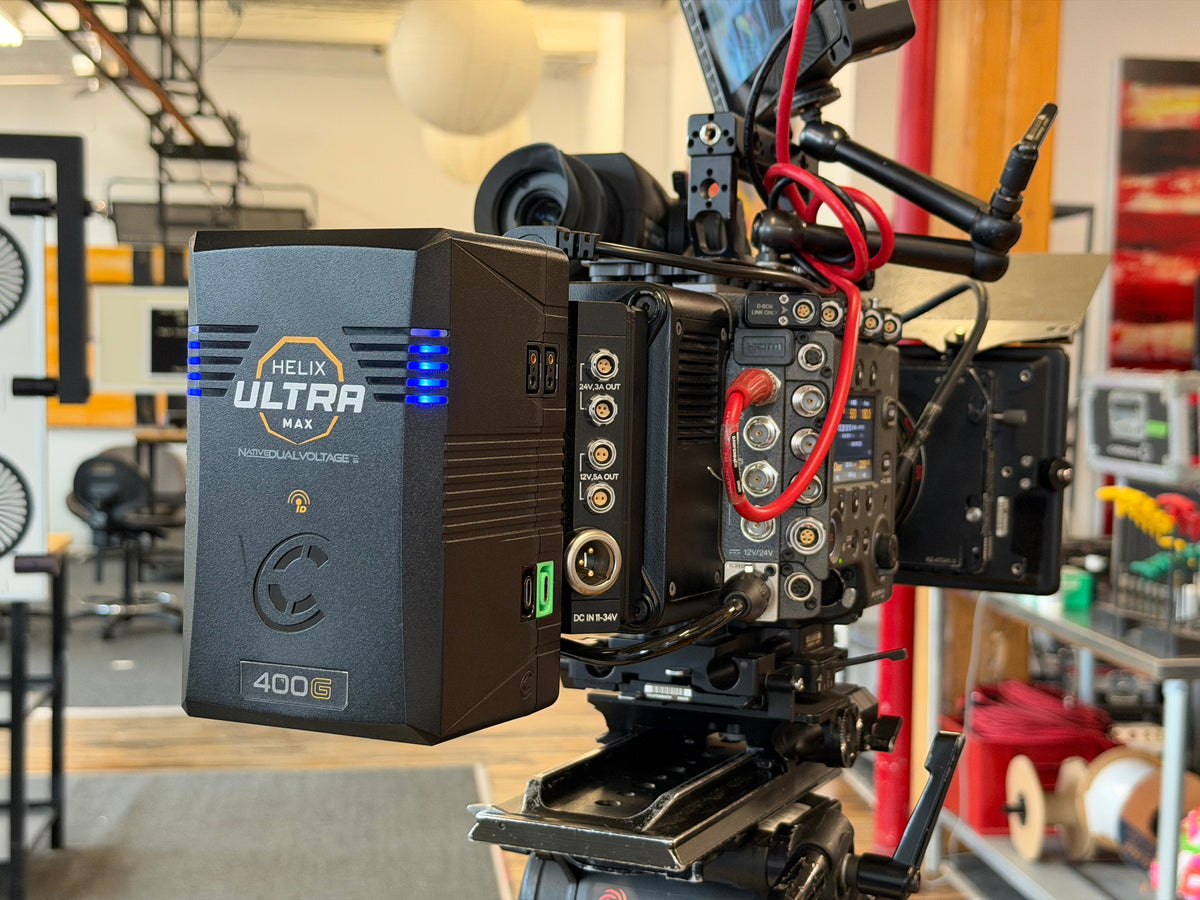
Peak power demands continue to increase with every new generation of cinema cameras.
Estimated Reading Time: 7 Minutes
Not Every Watt Is Created Equal
When comparing professional batteries, it’s easy to focus on capacity.
98Wh.
150Wh.
160Wh.
Capacity certainly matters because it determines how much energy is available.
But professional productions rarely fail because a battery didn’t contain enough energy.
They fail when that energy can’t be delivered when it’s needed most.
A modern battery isn’t simply asked to store energy.
It’s expected to deliver that energy consistently through rapidly changing loads, demanding accessories, and increasingly sophisticated camera systems—all while maintaining stable voltage and dependable operation.
Peak performance has become just as important as runtime.
Today’s Cameras Are Constantly Changing
Modern cinema cameras no longer consume power at a steady rate.
Recording begins.
Internal processors accelerate.
Cooling systems respond.
Displays brighten.
Wireless transmitters become active.
Lens motors engage.
External recorders begin writing data.
Power demand changes continuously throughout a production day.
The battery must respond instantly.
Delivering stable power during those transitions has become a defining characteristic of professional battery engineering.

More Than the Camera
Today’s batteries often power an entire production ecosystem.
Camera.
Wireless video.
On-board monitor.
Lens motors.
Audio receivers.
Timecode.
Networking hardware.
External SSDs.
Each accessory adds another variable.
Some devices draw power continuously.
Others create rapid spikes.
Others communicate while drawing power.
The battery isn’t supporting one device anymore.
It’s supporting an integrated production platform.
Delivering Power Is Different Than Storing It
There’s an important distinction between storing energy and delivering energy.
Almost every battery stores energy.
Professional batteries must also deliver it efficiently under demanding conditions.
High-current operation places greater demands on every part of the battery platform.
Cells.
Power conversion.
Conductors.
Connectors.
Battery management.
Thermal design.
Protection systems.
Communication.
Every subsystem contributes to how effectively power reaches the camera.
That’s why engineering doesn’t begin with watt-hours.
It begins with architecture.

Heat Increases as Power Increases
Higher current inevitably creates more heat.
Heat affects nearly every aspect of battery performance.
Electrical efficiency.
Cell aging.
Power electronics.
Component longevity.
Thermal stability.
Managing heat isn’t simply about preventing shutdowns.
It’s about maintaining consistent performance throughout extended operation.
Good thermal architecture allows the battery to continue delivering stable power even as operating conditions become more demanding.
That requires considering thermal performance from the earliest stages of engineering—not treating it as an afterthought.
Stability Builds Confidence
Professional users rarely notice good power delivery.
That’s because good power delivery isn’t dramatic.
The camera simply works.
Recording continues.
Accessories remain powered.
Production moves forward.
The absence of problems is often the greatest measure of engineering success.
Consistency builds confidence.
And confidence is ultimately what professionals purchase.
Professionals don’t remember the days when their battery worked perfectly. They remember the one time it didn’t.
Margin Matters Under Load
Engineering isn’t simply about designing a system that works.
It’s about designing one that continues working as operating conditions become more demanding.
Electrical margin.
Thermal margin.
Current margin.
Communication robustness.
Each contributes to the battery’s ability to handle unexpected operating conditions without compromising overall system performance.
Professional productions don’t occur under laboratory conditions.
Power requirements change.
Accessories are added.
Ambient temperatures fluctuate.
Equipment ages.
Designing with appropriate engineering margin provides flexibility for those real-world variables.
The Ultra Approach
One example of this philosophy can be found in Ultra.
Rather than focusing solely on increasing capacity or output, Ultra was engineered as a complete professional power platform.
Stable power delivery.
Robust communication.
Intelligent battery management.
Thermal optimization.
Protection architecture.
Long-term reliability.
Every subsystem contributes to the platform’s ability to deliver dependable performance under demanding operating conditions.
That’s because sustained performance isn’t determined by a single specification.
It’s determined by how the complete system works together.

Performance Over Time
Delivering peak performance on a new battery is relatively straightforward.
Continuing to deliver dependable performance after hundreds of cycles is considerably more difficult.
As batteries age, engineering becomes increasingly important.
Battery management.
Cell balancing.
Thermal performance.
Protection systems.
Firmware.
Charging strategy.
These systems continue working throughout the life of the product.
The goal isn’t simply impressive specifications on day one.
It’s maintaining confidence years later.
Looking Ahead
Camera platforms will continue evolving.
Power demands will continue increasing.
Connected accessories will become more sophisticated.
Battery engineering must continue evolving alongside them.
At Core SWX, we believe a professional battery should do far more than provide runtime.
It should provide confidence.
Confidence that the camera will boot.
Confidence that accessories remain powered.
Confidence that communication remains reliable.
Confidence that the system continues performing when production depends on it most.
Because ultimately, power matters most when nobody has time to think about it.
Key Takeaways
-
Modern cinema cameras operate under dynamic, constantly changing power demands.
-
Delivering energy consistently is just as important as storing it.
-
Stable power delivery depends on architecture, battery management, thermal performance, protection, and communication working together.
-
Engineering margin helps ensure dependable performance under demanding real-world conditions.
-
Ultra was designed as a complete professional power platform, emphasizing sustained performance, robust communication, and long-term reliability—not simply higher capacity.
About the Author
Ross Kanarek
CEO | Core SWX
Ross Kanarek has spent more than two decades developing professional power solutions for the cinema and broadcast industries. Throughout the industry’s transition from traditional battery platforms to today’s intelligent, high-voltage camera ecosystems, he and his team has worked closely with manufacturers, rental houses, broadcasters, and cinematographers to develop products that meet the evolving demands of professional production.

Share:
Built to Last